Skip to content
Anchor Points 
Pre-engineered or custom anchor points for many different applications.
Cable-Based Lifelines
Horizontal and vertical cable lifeline systems, for travel restraint or fall arrest.
Catwalks
Provide safe and easy access to elevated work stations while mitigating fall hazards.
Confined Space & Rescue
Equipment for access in confined spaces, or to allow for prompt worker rescue.
Ladder Systems
Safety systems designed to keep users on ladders protected from falls.
Loading Platforms, Stairs & Gangways
Passive safety systems that protect workers no matter what they need to access.
Portable Fall Protection
Systems that can be moved or stored as needed, for ultimate flexibility.
Rigid Rail Systems
In areas with minimal fall clearance, rigid rail systems are the solution.
Roof Fall Protection
Systems to protect rooftop workers from inboard and outboard fall hazards.
Roof Guardrail & Safety Railing
Passive safety solutions that don't require special training or regular inspections & testing to be compliant.
Suspended Access & Window Washing
Anchorage products, davits, monorails, and rigging sleeves for window washing and suspended access maintenance.
Staht Digital Pull Testing Kits

Digital pull testing equipment with advanced app integration.

DSC00330

If your worker is subject to a fall while on the job, Diversified has a solution. We can design, engineer, fabricate, and install fall protection systems for any application.

Aircraft & Aerospace
Proven fall protection solutions for aviation maintenance and manufacturing.
Construction
Permanent and temporary fall protection solutions for construction applications.
Feed & Grain
Solutions for feed & grain worker protection during storage, maintenance, transportation, and more.
Government & Military
Fall protection solutions for government and military installations, including aircraft hangars, rooftops, and more.
Healthcare & Education
Systems for hospitals, schools, universities, and more.
Industrial Applications
Versatile safety systems for industrial facilities.
Oil, Gas, & Chemical
Protect at-height workers on silos, towers, pipe racks, drilling platforms, rigs, and more.
Retail Fall Protection Equipment
Systems to protect workers at shopping and retail centers.
Road & Rail
Railcar, truck, and bus fall protection solutions.
Ship & Barge
Fall protection for ships & barges transporting oil, grain, materials, and more.
Stadiums, Arenas, & Convention Centers
Keep workers and visitors safe while protecting aesthetics at any large venue.
Steel & Foundry
Fall protection solutions for foundry and steel mill applications, including crane rails & more.
Suspended Access & Window Washing
Anchors, outriggers & rigging sleeves, davit systems, and more for suspended access.
Utilities & Energy
Systems for power plants, solar and wind generation, and more.
Data Centers
Systems that protect workers maintaining critically important data equipment. 

Rail (175)b-1

Not sure which system you need? Find the right solution for your application by industry.

Design & Engineering
Our in-house P.E.s and structural engineers design application-specific fall protection systems.
Fabrication

We also design custom products & solutions for a variety of applications.

Fall Hazard Assessment
A fall protection expert can visit your site to assess all fall hazards and ensure nothing is missed.
Fall Protection Programs
Create a comprehensive managed fall protection program in compliance with industry standards and ANSI/ASSP Z359.2 (2017).
Guardrail Rental
Need short-term safety? Rent OSHA-compliant guardrails from Diversified.
System Inspections & Recertification
We perform regular inspections,  recertification, & testing of systems, assuming liability for proper functioning.
Installation
Diversified has a network of installers nationwide who will ensure your system is installed correctly.
PPE Inspections & Recertification
Mail in your PPE or schedule an on-site inspection and recertification of your harnesses and connecting devices.
Repair

We trade out or repair damaged PPE and other equipment, and return it to service when possible.

Training
Required Authorized User & Competent Person training.
Virtual Rooftop Fall Hazard Inspections
Struggling to assess your facility's fall protection needs? Our specialists can remotely pinpoint roof hazards and solutions.
Window Washing Anchor Inspections
Annual inspection and recertification necessities for rooftop window cleaning anchors.

fall-protection-testing

Diversified will perform all necessary services to keep your site compliant, and provides and stores all documentation about its performance as required by OSHA.

Blog
Our blog has hundreds of articles detailing fall protection systems, best practices, industry updates, and more.
Product Literature
Educate yourself on all things fall protection and learn more about our fall protection products and systems.
Specifier Resources
Access our full technical document library.
OSHA & ANSI Regulations
A breakdown of current OSHA regulations and ANSI standards and how you can ensure your compliance
Free Fall Protection Webinars
Earn AIA continuing education credit with our free webinars. Several different topics are available each month, and can be watched on-demand for easy attendance.
Fall Clearance Calculator
Get a general idea of how much fall clearance a tie-off system requires.
ROI Calculator
Get a general idea of how much a single workplace accident can end up costing.
Industry News & Articles

Read our publications in other industry news outlets.

safety-configurator-guardrail-estimator

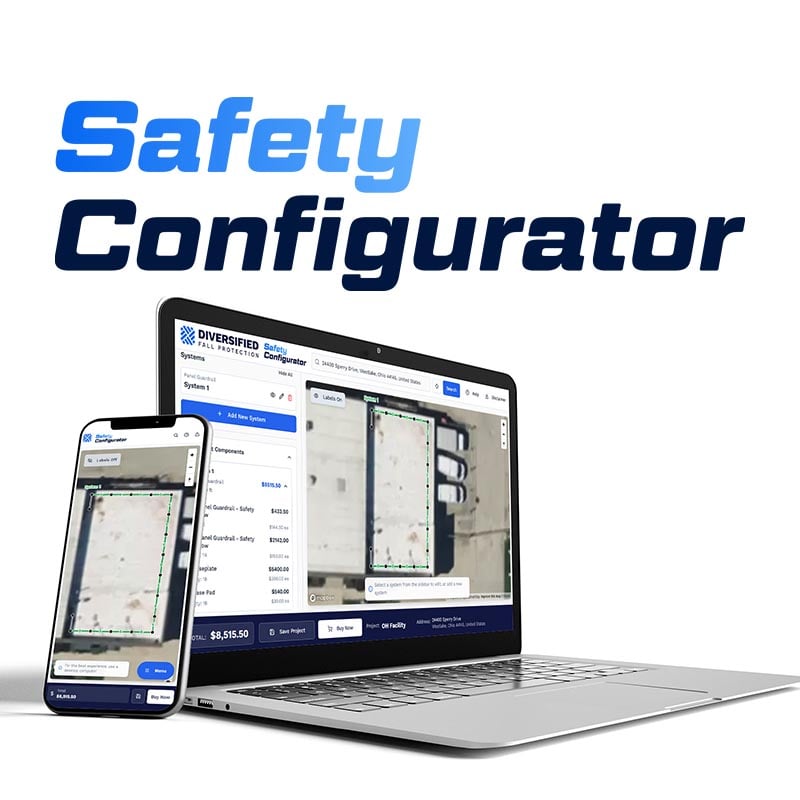
Our tool the Safety Configurator allows you to configure guardrail systems online, including instant pricing and even the ability to purchase online.

Please be aware that our offices will be closed for the holidays from Dec. 24 - Jan. 01. Merry Christmas!

Designing for Rescue Before the Rescue Plan Exists
16 Oct, 2026 Diversified Education Team

Designing for Rescue Before the Rescue Plan Exists

In new construction, fall protection systems are often designed and installed long before the people who will ultimately manage them occupy the building. Developers, general contractors, architects, engineers, and specialty contractors are focused on delivering systems that satisfy project requirements, while the future building owner, property manager, maintenance team, or EHS organization may not yet be identified.

The project team may know where equipment will be located and which areas will require maintenance access. It may not know who will perform that work, how many people will be present, or what resources will be available if a worker falls. Those unknowns affect the level of detail that can reasonably be established during design.

Designing for Rescue

Whether the project includes rooftop anchors and horiztonal lifelines or interior overhead fall arrest systems, rescue should be considered as part of the system design. DFP can help project teams understand how system selection and configuration may affect future rescue, identify appropriate rescue-capable equipment, and provide technical and application-specific recommendations. 

At this stage, the discussion should address what happens after a fall is arrested. Where could the worker be suspended? How could responders reach that location? Is there a practical route to move the worker to a safe area? The answers can reveal limitations that should be addressed while system locations, access routes, and equipment selections are still being coordinated. 

For example, a rooftop system may serve work near a building edge, where a suspended worker could be below roof level. An interior overhead system may serve an area occupied by machinery or other obstructions. Each arrangement presents different access conditions, and an approach that is feasible in one location may not be feasible in another. 

Rescue-capable equipment also needs to be evaluated in the context of the complete system and its intended use. The presence of an anchor or lifeline does not, by itself, establish how a rescue will be performed. Proposed rescue connections, equipment compatibility, and applicable system limitations need to be confirmed for the intended arrangement.

Developing a Rescue Plan

A detailed rescue plan, however, depends on information that may not exist during construction. Actual maintenance activities, personnel, access conditions, available responders, facility operations, and emergency procedures all influence how a worker would be rescued. Developing and maintaining those procedures is therefore an important administrative component of the facility's ongoing fall protection program. 

The plan must translate the proposed system capabilities into procedures that the people performing and supporting the work can carry out. That includes identifying who will initiate the response, who is trained and equipped to perform the rescue, where the necessary equipment is located, and how responders will access the affected area. 

These details depend on actual operating conditions. A building may use its own maintenance employees for one task and an outside contractor for another. Access may differ between occupied and unoccupied hours. Equipment that appears accessible on a drawing may require keys, controlled access, or coordination with facility personnel.

Understanding these conditions is essential to establishing rescue procedures that provide an effective rescue system and reduce injuries while the fall victim is suspended. 

The distinction between design and operations does not mean rescue arrangements should wait until after workers begin using the system. OSHA 1910.140(c)(21) requires employers to provide for prompt rescue in general industry. For construction, OSHA 1926.502(d)(20) requires prompt rescue or assurance that employees can rescue themselves. Applicable rescue arrangements must be in place for the work being performed, including any use during construction. 

Responsibility for the Operating Program

As the facility becomes operational, the owner or employer responsible for its fall protection program must establish site-specific rescue procedures appropriate for how the systems will actually be used in the future. The employer retains responsibility for meeting the applicable OSHA rescue requirement. Unless expressly contracted, DFP's role is to help make that future planning possible, not to prematurely define an operational program on the owner's behalf. 

A useful transition from construction to operations includes communicating the installed system’s intended uses, limitations, and any rescue-related assumptions made during design. That information gives the operating team a basis for developing its procedures and identifying questions that still require resolution. It does not replace the team’s evaluation of its work activities, personnel, and available response resources. 

As maintenance tasks, equipment layouts, staffing, or access conditions change, the facility should review whether its rescue procedures remain workable. A system designed with rescue in mind supports that process, but the procedures still need to reflect the conditions under which people are working. 

Our goal during new construction is not to create an operational rescue plan before the operation exists. It is to help ensure today’s fall protection decisions do not become tomorrow’s barriers to an effective rescue strategy.

Schedule an assessment with Diversified Fall Protection

Contact Us to request a fall safety review