

b-1.jpg?width=1368&height=1340&name=Rail%20(175)b-1.jpg)
How to Manage a Comprehensive Fall Protection Program
Originally Published May 8, 2025
Workplace Material & Handling
Fall protection programs are commonplace for organizations across several industries to protect their workers at-height. Among the construction & general industries, falls are a leading cause of injury & fatality, affecting thousands of employees annually.
Fall fatalities are preventable – if organizations provide the correct resources, training, and equipment to their workers. Identifying the resources required to accomplish this task can only begin once an effective fall protection program is established. The main purposes of a fall protection program are to identify all fall hazards, eliminate or control those hazards, designate & train employees on how to comply with the program, and maintain documentation for all fall protection equipment & procedures used by the organization.
Identify Fall Hazards
In order to effectively protect workers, organizations must conduct fall hazard assessments in their facilities to identify any fall hazards. Fall hazards can require different mitigation methods depending on the industry or frequency of the task being performed. Thus, most companies use their local OSHA regulations to help determine where fall protection is legally required in their facility. For example, OSHA 1910.28 for General Industries requires fall protection whenever an employee works 4ft or more above the next lower level. OSHA 1926 Subpart M for Construction companies requires fall protection for employees exposed to falls of 6ft or greater. Once minimum regulatory compliance is achieved, organizations are encouraged to exceed those minimum compliance standards if it means a more reliable or effective form of fall protection.
Once fall hazards are identified, organizations must compile details about the work being performed near these hazards and determine the most effective fall protection. Details, such as the frequency of work being performed and the number of employees that perform the work, will help determine what fall protection methods will be more effective in protecting these workers.
Eliminate or Control Hazards
Once fall hazards are identified, organizations must decide how to eliminate or control the fall hazard. When brainstorming ideas for solutions, it is helpful to refer to the Hierarchy of Fall Protection Controls to determine the effectiveness of any proposed solutions. The Hierarchy lists the various fall protection methods in descending order of how effective they are at preventing injury:
-
Hazard Elimination
-
Passive Fall Protection
-
Active Travel Restraint
-
Active Fall Arrest
-
Administrative Controls
Hazard Elimination sits at the top of the Hierarchy because eliminating the chance of a fall occurring is, obviously, the most effective way to prevent injury. In other words, a worker cannot be injured from a fall that does not happen. Hazard elimination can be accomplished by changing how or where elevated work is performed. For example, upgrading to drop-down lighting fixtures in a facility can eliminate the need for workers to climb ladders or use scissor lifts to change overhead lighting. Or, in construction, using pre-fabricated trusses can decrease the amount of time workers spend at heights. For rooftops, architects or building designers can utilize tall parapet walls to prevent workers from being exposed to unprotected rooftop perimeters.
Passive Fall Protection & Active Travel Restraint both aim to prevent falls from occurring through equipment installation. Guardrail is a perfect example of a passive fall protection system. It requires no training or user input, and its performance is not dependent on the worker’s capabilities. Guardrail’s simplicity is what makes it so effective at preventing falls.
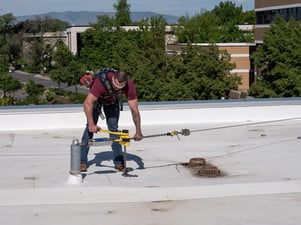
Active travel restraint, on the other hand, requires a worker to don a fall protection harness and attach a lanyard to their designated anchorage. These systems prevent falls from occurring by not allowing the worker to physically reach their fall hazard. For example, a worker would be considered using travel restraint if they attach a 6ft lanyard to an anchorage located 10 feet away from the edge of their walking working surface. Since their lanyard only extends 6 feet, there are 4 feet of space separating the worker from the fall hazard. As long as the work remains connected to their system, they will be prevented from falling. However, disconnecting from their system can leave them exposed to a fall hazard with no means to prevent their fall.
Active Fall Arrest is commonly used, and many workers are familiar with the required equipment. Similarly to active travel restraint, body harnesses & anchors are used, but with the addition of a connection device that decelerates the fall and absorbs fall forces. It is important to acknowledge, though, that fall arrest solutions do not prevent a fall from occurring; they simply attempt to decrease the severity of injury to the worker once a fall occurs. However, many factors can reduce the effectiveness of fall arrest equipment, such as an ill-fitting body harness, insufficient fall clearance allotted for the chosen connection device, or improper equipment use leading to failure. Since fall arrest solutions do not prevent falls and are vulnerable to user negligence, they are almost at the bottom of the Hierarchy. Additionally, organizations are required by OSHA to generate rescue plans whenever fall arrest equipment is utilized.
Administrative controls should be reserved for emergencies or only while more robust fall protection equipment is being installed. A safety monitor is an example of an administrative control and is permitted as a means of fall protection under certain circumstances. A safety monitor is a designated employee who watches workers at-heights and stays in constant communication to help prevent the workers from falling. Administrative controls exist at the bottom of the Hierarchy because no equipment is used to prevent a fall or mitigate injuries, and should be used as infrequently as necessary.
It is important to note that it is possible to maintain OSHA minimum compliance using any level of the Hierarchy in various scenarios. However, maintaining regulatory compliance does not guarantee success. While this author sympathizes with budget or productivity constraints that sometimes influence decision-making, organizations must acknowledge that the health & well-being of their own workforce can be jeopardized when less effective fall protection solutions are selected over more effective ones.
Designate & Train Employees
Before employees can use fall protection equipment, OSHA requires organizations to designate the Authorized Users and provide initial training. According to OSHA 1910.30, Authorized Users must be trained on how to recognize the fall hazards in their work area(s), the control procedures in place to mitigate those hazards, and how to properly use their supplied fall protection equipment. OSHA does not explicitly dictate a frequency for retraining employees, but industry consensus suggests retraining on an annual basis at minimum. OSHA only requires retraining if workers display a gap of understanding that could put themselves or others at risk, or if there are sudden changes to the fall protection equipment or procedures.
OSHA also requires every organization to have at least one employee to serve as its designated Competent Person. This individual must be certified by completing a 16-hour course provided by an ANSI-accredited training organization. The Competent Person must take a refresher course & certify every two years.
The Competent Person will be the primary facilitator of the entire fall protection program. They are tasked with training Authorized Users, performing annual equipment inspections, conducting fall hazard assessments, and taking prompt corrective actions when fall hazards are identified. Technically, they are the only individual within the organization who can approve any changes made to the fall protection program. While only one Competent Person is required, companies would benefit from having multiple people with the knowledge & capabilities of a Competent Person in case someone is unavailable and quick decisions must be made to ensure worker safety.
Maintain Documentation
Comprehensive fall protection programs should be living, breathing documents that are continually referenced to ensure their effectiveness. OSHA requires equipment inspections, employee training, and incident reports to be documented & maintained for reference. In the event a fall occurs and employees are injured (or worse), documentation is typically one of an employer’s only ways to demonstrate compliance and limit their liability. That is, a lack of proper documentation can be perceived as a lack of preparation.
Continuous Improvement
Once a fall protection program is fully established, the work has only just begun. Every day can bring a new challenge, and worker safety should never be taken for granted, no matter how robust the fall protection program may seem. Organizations should frequently ask their fall protection users for feedback on their equipment & procedures to ensure user compliance & ultimate effectiveness. Providing equipment is one thing, but ensuring its proper use is another. If fall protection is not used correctly, workers can be subject to preventable injuries. Training sessions are a great opportunity to reaffirm fall protection best practices to employees and confirm they demonstrate the capability of following them.
Schedule an assessment with Diversified Fall Protection
Contact Us to request a fall safety review