


b-1.jpg?width=1368&height=1340&name=Rail%20(175)b-1.jpg)
Here’s a common scenario: you’ve performed a fall hazard assessment of your entire facility, and you’ve identified every hazard that needs some sort of fall protection. Depending on the size of your facility, that list could be quite long, and the quote you’re handed from your fall protection provider might be more than you were initially expecting. All of a sudden, providing safety has a price tag attached to it, and that price might take up more of your budget than management will approve. At least all at one time.
So, what can we do? How can we decide between what is more important: adhering to our budget or protecting our workforce from these workplace hazards? Before we get too philosophical and make claims that could make our HR team uncomfortable, let’s discuss how companies can pragmatically evaluate and implement fall protection solutions over time that don't compromise worker safety while also gaining approval from their financial teams.
Because here’s the reality we’ve seen far to often: if safety departments ask for too much at once, they risk getting projects denied completely, and then their organization is open to compliance liability, and, worse, workers run the risk of getting injured while working. The former can be addressed and rectified, but the latter can never be undone and must be avoided at all costs (no pun intended).
Here are a few steps we can take to incrementally implement fall protection at a pace that prioritizes worker safety while adhering to financial constraints.
1.) Utilize a Risk Matrix Calculator
When you perform fall hazard assessments, we suggest running every fall hazard through a risk matrix calculator to assign a score to each fall hazard. After the assessment is complete and every hazard has been scored, we begin by working our way down the list in descending order of their risk rating. In other words, we address the most dangerous or likely scenarios for worker fatalities or injuries first.
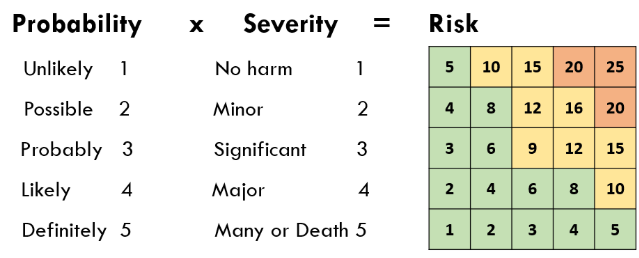
Our risk matrix calculator multiplies the probability of a fall occurring by the severity of the potential resulting injury. To demonstrate how to use the calculator, let’s look at one common fall hazard many facilities can relate: a worker climbing a permanent, fixed ladder that has no fall protection system installed.
In this scenario, the risk is that the worker can fall from the ladder at any time, and there is no equipment in place to arrest their fall. Combining that limited information with the statistical evidence behind ladder injuries & fatalities, we would assign the probability of a fall occurring at Likely (4) and the severity of the injury as Many or Death (5). This would give us a Risk Factor of 20 for this scenario, which falls within the “red” zone in our matrix calculator.
2.) Using the Results to Prioritize Fall Hazards & their Solutions
After putting all of your potential fall hazards through the Risk Matrix Calculator, you should have a list of your hazards and can rank them from highest to lowest priority. While compiling quotes & estimates for fall protection solutions, you can now bring HR & finance into the conversation to quantify which hazards can be afforded within your existing budget and have a systematic approach to mitigating the most likely or most dangerous hazards first.
3.) Cost-Benefit Analysis – Costs of Purchasing Safety Equipment vs. Costs Associated with Workplace Falls
Another helpful tool for safety managers & decision makers to help “make the argument for safety” is to help their organizational leaders understand the potential costs of a workplace fall. However, we first must stress the point that financial burdens to a company pale in comparison to the pain & torment an employee will experience during a non-fatal fall, let alone the traumatic effects many others go through when an employee experiences a fatal fall.
The National Safety Council (NSC) estimates that companies spend an average of nearly $50,000 when a non-fatal workplace fall occurs. Most of these costs are related to workers’ compensation, OSHA citation fees, litigation fees, and other medical expenses for the fallen worker. In our industry, these are known as “direct” costs that are incurred by the employer when a fall occurs. “Indirect” costs are other factors that impact a business and are more difficult to quantify & directly correlate with the specific fall incident. Some examples of indirect costs include, but are not limited to facility or job-site shutdown time to respond to the incident, employee turnover, employees calling out “sick” after a fall occurs, loss of business because of negative press, tarnished reputation from poor safety & health policies, costs associated with replacing an injured or deceased worker, time spent training existing workers to prevent future falls, etc. Some experts suggest that indirect costs can add up to as much as four times the amount of direct costs!
Moreover, when falls occur and OSHA citations are issued, many companies are placed under strict abatement deadlines to implement a mitigation method to prevent a similar incident from happening again. That will severely impact the “shopping” process of evaluating fall protection providers for mitigation methods and will likely result in higher overall costs for a similar solution that could have been more affordable without an impending deadline looming.
Once all of that information is considered, many folks are able to finally see that providing fall protection equipment is in the best financial interests of the company and, simultaneously, what is best for the workforce. To quote Benjamin Franklin, “An ounce of prevention is worth a pound of cure.” In this context, it means that preventing a fall is ethically and financially preferable for a company than scrambling to provide a solution after a tragedy. We can’t bring people back from the dead or uninjure the worker, but we absolutely can avoid preventable falls from occurring.
Conclusion
Every business will have different levels of exposure to falls, but every company will have to go through similar processes and incur costs if a fall occurs. Nearly 2-3 workers die every day from workplace falls, and many of those falls were preventable.
The solutions exist; the providers are willing to work within your budget, timeline, and expectations; but it takes your organization to take the first step and begin the process of prioritizing the protection of its workers. With the right coordination of planning, employee training, and vendor capabilities, we can hope to prevent all future falls and avoid preventable tragedies.
Take the first step today in protecting your workers from preventable falls and fill out our contact form.