


b-1.jpg?width=1368&height=1340&name=Rail%20(175)b-1.jpg)

In this article , you'll learn:
- When a fixed ladder may still require retrofit even if the ladder itself is under 24 feet
- How OSHA evaluates fall exposure, not just ladder length
- Why ladder cages and platform breaks can create gray areas in retrofit decisions
- When code minimums differ from a proactive fall protection strategy
- What building owners should know about retrofit deadlines for older fixed ladders
As you might already know from one of our past blog posts, federal OSHA 1910.28 now requires fixed ladders 24 feet or greater to include fall protection via a ladder safety system or fall arrest system. This standard update took effect in November 2018 for all newly-installed fixed ladders. Fixed ladders installed before then have until 2036 to be brought into compliance, unless the ladder undergoes repair, maintenance, or construction, in which case retrofitting must be completed at that time.
If you’ve read our blog post regarding the OSHA 1910.28 update regarding fixed ladders, you’ll know that the clock is ticking on retrofitting with a ladder safety system to comply with the new regulation.
However, over the years, several customers & webinar attendees have raised numerous examples of fixed ladders that fall into a “gray area” and have wondered whether their fixed ladders are eligible for retrofit under the new standard. Let’s take a look at some examples and discuss whether these fixed ladders in question are affected by the new standard.
Gray Area #1: When a Fixed Ladder Is Under 24 Feet but the Fall Exposure Isn’t?
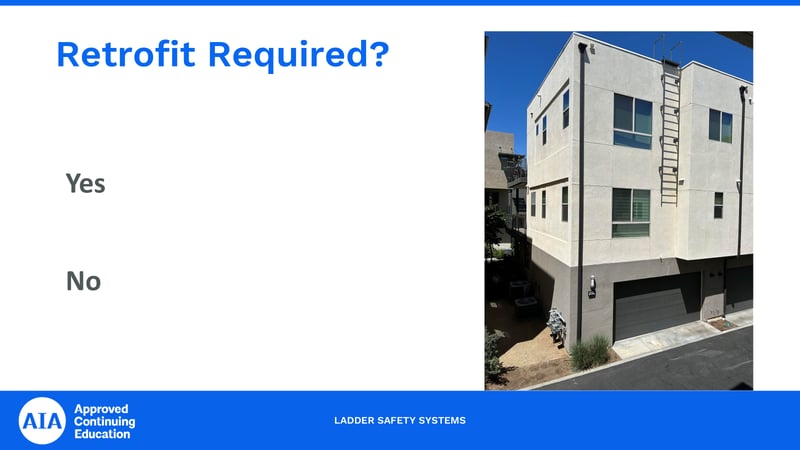
In this example, we have a fixed ladder that does not extend all the way to the ground level. This is, unfortunately, quite common on buildings where the owner wants to discourage the public from unauthorized roof access. This creates other potential hazards when contractors or maintenance workers must use these ladders to access the rooftop, but that’s a topic for another blog post.
Using the “count-the-rung” method of estimating ladder height (assuming the ladder rungs are 12 inches apart), this fixed ladder appears to be approximately 18 feet long. At first, one might think that this fixed ladder is not eligible for retrofit. However, it’s important to remember that the OSHA 1910.28 update pertains to fixed ladders that expose a worker to a fall of 24 feet or greater (20 feet or greater in California). Since this ladder begins at the second story of this building, within climbing a few rungs of the ladder, the worker would be exposed to a 24-foot fall and we would recommend retrofitting this fixed ladder as soon as possible.
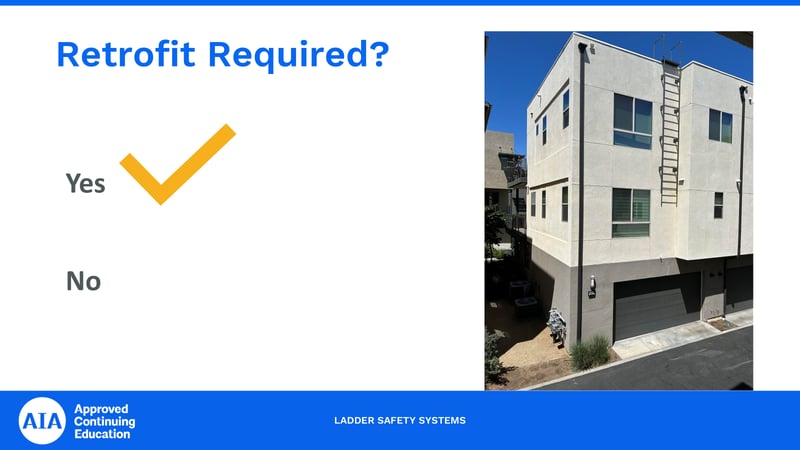
This ladder also brings up another point on fixed ladder safety that is worth discussing. Just because a fixed ladder does not expose a worker to a fall of 24 feet or greater, all fixed ladders would benefit from a ladder safety system, whether required by OSHA or not. Ladders are one of the most common causes of fall injuries, and most ladder deaths occur under ten feet! A proactive safety program would aim to equip every fixed ladder with a ladder safety system to protect workers climbing any fixed ladder in the facility.
Gray Area #2: Do Fixed Ladders With Cages and Platforms Above 24ft Require a Retrofit?
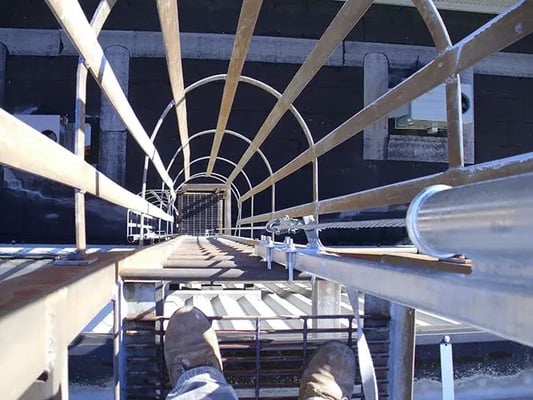
In this next example, we see a series of fixed ladders used to scale a tall facility. For the sake of this post, we will assume each ladder segment is just under 24 feet tall. However, the presence of ladder cages is what makes this example difficult to determine retrofit eligibility.
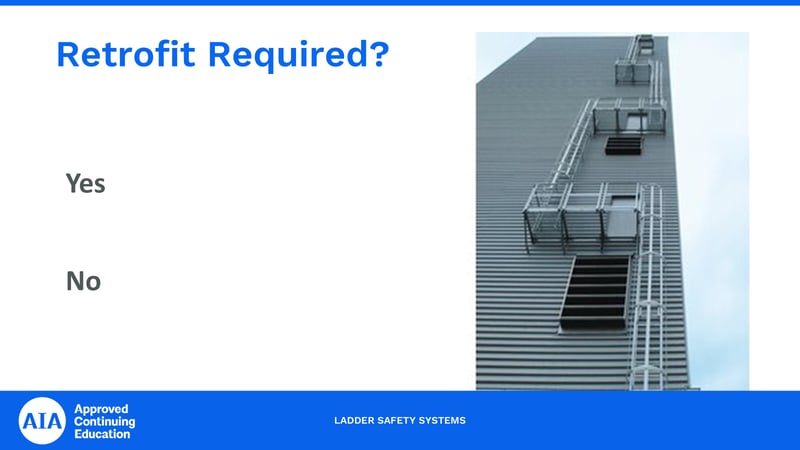
First, remember that ladder cages are not incompatible with the new OSHA standard. They are, however, no longer considered a form of fall protection. Unless ladder cages prohibit or impede the installation of a ladder safety system, they can remain on fixed ladders. In fact, ladder cages are helpful in providing a 30” clearance around the ladder climber, which is required by OSHA 1910.23 fixed ladder qualitative requirements. They can also provide support for workers to lean against or rest on while climbing extremely tall ladders.
Second, if ladder cages were not present on the upper ladder sections, then the worker could potentially be exposed to falls exceeding 24 feet, regardless of the ladder's material height. Further, breaking this ladder into multiple segments with transition platforms will make climbing the exterior of this building much less daunting than a single continuous climb.
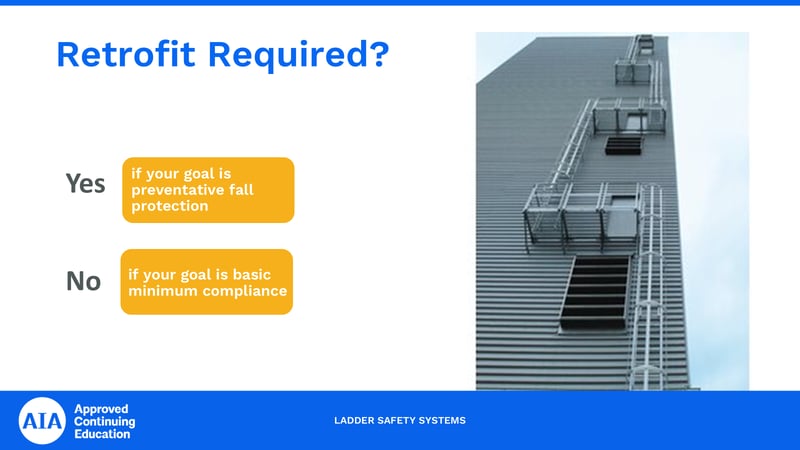
That said, is retrofitting required for these ladder segments? Well, it really comes down to what the goals of your organization’s fall protection program are. If your goal is simply to maintain basic OSHA compliance, then retrofitting each ladder segment (assuming they are less than 24 feet tall) would not be required. The ladder cages and the rest platforms constructed at the bottom of each segment would prevent falls greater than 24 feet.
But with that said, we hope that your fall protection program’s goal is not simply to meet bare minimum OSHA requirements, but to be proactive enough to protect workers from all potential fall-related injuries. Falling from any height can cause significant injury, and there is no way to predict the potential violence of an accidental fall. With that line of thinking, we would still recommend retrofitting each of these ladder segments with a ladder safety system to do as much as possible in preventing major injury or fatality for the worker.
A quick refresher on the 2018 update to OSHA 1910.28 regarding fixed ladders
Effective November 2018, all permanent, fixed ladders over 24 feet now require a personal fall protection system (or ladder safety system) to be installed. This pertains to any permanent, fixed ladder that exposes a worker to a fall hazard of 24 feet or greater, regardless of the ladder’s material length or location in the facility. If the worker can fall 24 feet or more at any point in climbing the ladder, that fixed ladder will be required to comply with this new standard. In the state of California, Cal/OSHA has adopted the same update, but pertaining to fixed ladders 20 feet or greater.
If a ladder was installed in a facility before the November 18 effectiveness date, the building owner has until November 2036 to bring that ladder into compliance. However, retrofitting must occur before 2036 if an eligible ladder goes under any repair, maintenance, or construction. The building owner must install the fall protection equipment while performing the ladder's maintenance or repairs. It’s important to note that OSHA considers a newly-repaired ladder a “new” ladder, and since 2018 all “new” permanent, fixed ladders over 24 feet must be equipped with some form of fall protection.